Archives – December, 2009

BORIS PREACHING GREENERY @ COPENHAGEN

Boris pointingAs often happens with the newly converted, Boris is now piously preaching to the rest of us on all matters green, for example in his latest Telegraph column on his way to the sideshows at the Copenhagen Summit. Not that he necessarily practises what he preaches. For a start, it would have been better if he had made the effort to get to Copenhagen by train via Brussels rather than on a short-haul flight.

Nor was it clear what he was doing there. Telling the world how London shows the way with retrofitting public buildings and promoting electric cars is all very well, but Boris can take little credit for the former policy, which was launched under the previous Mayor. As for electric cars, it is not at all clear that the Mayor is in a position to lead on this, given that the vast majority of charge points will have to be on suburban roads controlled by local authorities and not on the TfL red routes where we rightly have little off-street parking. And Boris fails to explain what the source of supply for the electricity will be. Is it to be from renewable energy sources or from the sources we are already using? If the latter, then even if electic cars would reduce noise and air pollution they would contribute little to reducing our carbon emissions.

And whilst Boris is preaching to the world about London’s achievements, we should not lose sight of the fact that, according to the Economist Intelligence Unit’s recently published European Green City Index, we are only a middle ranking city when it comes to greenery – in 11th place, just behind Paris. That’s the reality: in the European cities league table we occupy an equivalent position to Fulham or Sunderland in the Premier League, not Chelsea or Man United. Quite honestly only the host city Copenhagen, which comes out top of the Green City Index, is entitled to go preaching to the rest of the world on what cities can do to reduce their residents’ combined carbon footprint.

While he has a look at the tables in the Green City Index and London’s position in them, Boris should also take time out to reconsider his neo-Malthusian views on population growth as a cause of potential environmental catastrophe. (“We are replicating too fast,”, he tells his Telegraph readers, “hurtling towards nine billion souls on the planet like bacteria multiplying on a Petri dish.”) While the Evening Standard has highlighted how this does not fit very well with Boris himself having four kids (which of course is a personal choice), a more fundamental criticism is that the perspective of disaster caused by rising population has been discounted on numerous occasions before in history.

As I wrote about advocates of neo-Malthusianism in an earlier post:

“What they do not want to admit is that the fertility rate of half the world is now 2.1 or less, the magic number consistent with stable population, and that it’s expected to fall below this level between 2020 and 2050. (See the recent article in the Economist.) That’s not surprising as poor countries are going through the same demographic transitions that rich ones went through, but at an earlier stage in their development and much more quickly.

“As for environmental damage, the poorest people in the world like the Bangladeshis are producing at most 0.3 tonnes of CO2 emissions per capita annually, whereas a US citizen produces 20 tonnes. So, while it’s clear that if the poor countries recreate the same consumption patterns as the US we will certainly have some problems to deal with in the future, at present that is a distant prospect. It is the environmental damage caused by the developed countries that is the immediate challenge.”

Boris’s time in Copenhagen would have been better occupied advocating that cities should be party to any agreement, given that 75 per cent of the CO2 emissions originate from cities and the human race has reach a point now that 50 per cent of it now lives in these huge urban centres. Particularly now that nation states have proved unable to agree amongst themselves on the way forward after the Kyoto agreement, Boris should be calling for cities to step into the breach. Now that would be some leadership!

Leave a Comment December 19, 2009

MUSLIM STATES AND CLIMATE CHANGE

Qatar oil
Oil refinery in Qatar

Speaking at a meeting of its Standing Committee for Economic and Commercial Cooperation at Istanbul in November, Bangladeshi president Zillur Rahman called on the Organisation of the Islamic Conference (OIC) to take a lead in combating climate change and in supporting countries like Bangladesh that are fighting the consequences of global warming, even though they make little contribution to its causes. Up to now, however, the OIC’s record on this has been poor.

A 2007 study concluded that the rich Arab states in the OIC had been reluctant to take a lead on addressing climate change: “… efforts by wealthier Muslim states are imbalanced with many of them doing very little and not acknowledging the urgency of the issue. Saudi Arabia, who holds most of the purse strings of the OIC, has long been a sceptic of climate change.” Indeed, the response of Saudi Arabia’s lead climate change negotiator at Copenhagen, Mohammad Al-Sabban, to the leaked emails from the University of East Anglia’s Climatic Research Unit was: “It appears from the details of the scandal that there is no relationship whatsoever between human activities and climate change.”

Looking at annual CO2 emissions per capita in the Gulf states (International Energy Agency figures for 2007), it is immediately apparent that the figures are much worse than even for the United States, which is usually seen as the villain of the piece. For example, Qatar’s annual emissions stand at 58.01 tonnes per capita, the United Arab Emirates’ at 29.91 tonnes, Bahrain’s at 28.23 tonnes and Kuwait’s at 25.09 tonnes, whereas the figure for USA is 19.10 tonnes. These emissions are even more astonishing when compared with the figure for Bangladesh, which stands at 0.25 tonnes per capita. It does make you wonder what is being done in these rich Arab Gulf states to produce such huge CO2 emissions.

As for discussions on climate change amongst the Arab states, here again the problem is the reluctance of the ruling elites in oil-rich countries to support any measures that might reduce demand for oil and petrol. This despite the fact that the Middle East is particularly vulnerable to rising temperatures, with vast areas of agricultural land between Egypt and Iraq expected to lose fertility as a result of global warming.

In November, at the launch of the UN Population Fund (UNFPA) report on climate change in Cairo, UNFPA officials pointed out that 15% of people in the Arab world already have limited or no access to potable water and that water scarcity induced by climate change was expected to cut food production in the region by half. They called for more cooperation between the Arab League, UNFPA, and Arab NGOs to help governments draw up appropriate policies.

A report released in November by the Lebanon-based Arab Forum for Environment and Development (AFED) criticised the near complete lack of research data on climate change in Arab countries and called on Arab nations to immediately draw up adaptation and mitigation plans. One of the authors stated that “we have no data about the effects the greenhouse gas emissions in the atmosphere will have on our coastal zones, even though we know they are very vulnerable”, adding that this makes creating plans to reduce risks from climate change difficult.

Not surprisingly, we have come to expect very little from the OIC in such global environmental summits as we are seeing in Copenhagen this week, where the negotiations on behalf of the developing world are undertaken by the G77 plus China. We hear much talk about the importance of the ummah as the basis for international unity among Muslims, but the oil-rich states have so far shown little sense of unity with their co-religionists over such a critical issue for mankind as climate change and global warming.

In addition to the conference of the parties reaching an agreement on limiting global warming to 2C over pre-industrial levels, the other bone of contention at the Copenhagen Summit is clearly money. That is, how much wealthy countries will be paying poor ones to help them deal with climate change. Given the huge sovereign funds that many of the oil-rich Muslim-majority states are sitting on, derived essentially from the sale of hydrocarbons, and given that the burning of these fuels makes a major contribution to greenhouse gases, you might think the oil producers would feel some moral obligation to the nations who suffer the consequences of global warming.

Moreover, at present the huge funds that the oil-producers possess are usually invested into property and assets in the developed world, when investment in the developing world in green industries and the low carbon economy could well give them better returns and certainly a better conscience. Now that would be a grand idea for all those funds standing idle in bank accounts in the world’s major cities. In the meantime, some zakat to those on the front line of climate change in countries like the Maldives and Bangladesh is surely not too much to ask.

Published in the Jakarta Globe, 16 February 2010

5 Comments December 17, 2009

QUEEN’S PARK BY-ELECTION, CITY OF WESTMINSTER

Patricia McAllisterThe immediate political consequence of the death of my father Mushtaq Qureshi, who was a serving Councillor for the Queen’s Park ward in the City of Westminster, was that a by-election was called on the 10th of December. Given the general trepidation caused by such elections, and after the shock of losing the Church Street by-election in July 2008, you would be forgiven for thinking that Labour had a lot to fear.

In the event, whilst there was a low turnout (16.46 per cent), which was to be expected given the proximity to the Christmas break, we held the seat comfortably, with a very satisfactory 11 per cent swing to Labour from the Tories. It was one of Labour’s best results in London this year. This should be of real concern to the Tories, as they threw everything at this by-election and were rewarded with their worst result for over a century, getting the lowest numerical vote for any Tory candidate in Queen’s Park since 1903. Although it was the first time the Greens had contested the ward, their candidate Susanna Rustin came third, beating the Lib Dems into fourth place. All this bodes well for Karen Buck MP in the new Westminster North seat in the forthcoming general election.

Finally, my father would have been delighted to see his political legacy bringing about such a decisive Labour victory and providing a firm foundation on which to build a Labour campaign in next year’s general election and council elections. And the newly elected Councillor Patricia McAllister (pictured) will make a worthy representative of the community in Queen’s Park for years to come.

Leave a Comment December 12, 2009

LONDON CALLING FOR CLIMATE JUSTICE

Climate Hearing 6

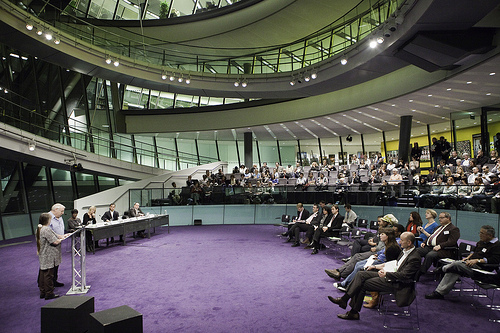
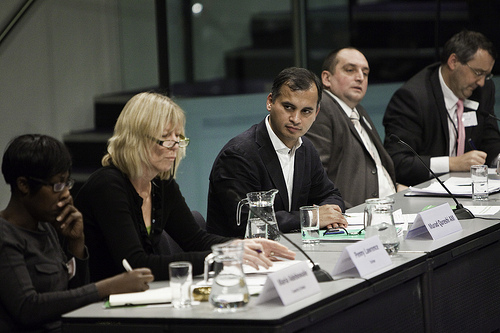
Last week the London Assembly Environment Committee and Oxfam jointly organised a Climate Hearing at City Hall, where we heard for the first time from London’s traditional and diaspora communities about the impact that climate change has had on their lives both here and in their ancestral homes. We also heard from experts what cities can do to limit our combined carbon footprints and saw a production by the Blue Elephant youth theatre on the impact of climate change in South Asia. That’s all before we concluded with a panel discussion on the issues brought up during the evening.

This event took place against the background of a raging debate over the alleged manipulation of the time series on increasing global temperatures produced by the Climatic Research Unit at the University of East Anglia. In a radio interview on LBC following the Climate Hearing, I came to the defence of UEA’s Prof Phil Jones by simply asking: why all of a sudden have 13-year-old emails been given such prominence? It’s not difficult to work out that it must have something to do with the Copenhagen Summit next month and some people’s attempts to undermine it! In fact the UEA time series tallies with that of NASA, and I don’t hear anyone accusing them of manipulating the evidence. In any case, it is not just these time series that show the world is warming but a range of sources including other indicators like sea level rises, glacier retreats and the reduction in Arctic sea ice.

On top of this, the previous week we had the United Nations Population Fund (UNFPA) suggesting that family planning, reproductive health care and gender relations could influence the course of climate change and affect how humanity adapts to rising sea levels, worsening storms and severe droughts. The spin put on this by the media was that population growth in the developing countries is a major threat to the future of the planet.

Now you can imagine how neo-Malthusian outfits like the Optimum Population Trust jumped at this opportunity to peddle their half-truths. What they do not want to admit is that the fertility rate of half the world is now 2.1 or less, the magic number consistent with stable population, and that it’s expected to fall below this level between 2020 and 2050. (See the recent article in the Economist.) That’s not surprising as poor countries are going through the same demographic transitions that rich ones went through, but at an earlier stage in their development and much more quickly.

As for environmental damage, the poorest people in the world like the Bangladeshis are producing at most 0.3 tonnes of CO2 emissions per capita annually, whereas a US citizen produces 20 tonnes. So, while it’s clear that if the poor countries recreate the same consumption patterns as the US we will certainly have some problems to deal with in the future, at present that is a distant prospect. It is the environmental damage caused by the developed countries that is the immediate challenge.

More recently we have also seen “climate change sceptics” like Melanie Phillips and Nick Griffin coming together in a de facto alliance to question the basis of the Copenhagen Summit. So it’s all too apparent what the political forces are behind the questioning of the science. In fact, if you were genuinely sceptical, as they make out they are, would you not at least adopt the precautionary principle and act now in order to avoid even the possibility of future environmental disaster? Alas that is not their thinking. The Mad Mels and Nick Griffins are not really sceptics but rather climate change deniers who are ideologically committed to rejecting the science, although of course neither would admit that publicly.

We can expect more of this nonsense all the way through to the Summit and during it as well. I am just glad we had the opportunity to hold a Climate Hearing here in City Hall, when London called for a global shout for climate justice.

As for my wish list for the Copenhagen Summit, I would like to see the following: a cap on the developed world’s emissions, a global deal on aviation emissions and the Tobin Tax to fund the climate change adaptation and mitigation required in the developing world. I trust this is not too much to expect!

Climate Hearing 1

3 Comments December 1, 2009


Categories

Links

Meta