Following the fire in Dean Street on July 10, I wrote to the Fire Commissioner Ron Dobson in my capacity as a London Assembly representative on the London Fire and Emergency Planning Authority, asking for his comments on the concerns raised by constituents.
Press reports had indicated that the Soho fire station in Shaftsbury Avenue was unmanned when the fire broke out, with its appliances and firefighters away attending another fire. It had also been suggested that the computer system which calls in a standby fire engine from the nearest available station had been overridden, resulting in a delay in appliances arriving from the Euston and Knightsbridge fire stations.
The commissioner promptly wrote back to me with a detailed response to the points made. He confirms that the appliances from Soho fire station were attending two other incidents at the time the call was received to the fire at Dean Street – one at Covent Garden Underground station and another at the Carlton Club in St James’s Street.
As the commissioner points out, the situation can arise where the appliances and firefighters from a particular fire station are already attending a prior call at the time that a potentially more serious call comes in. However, because fire cover is provided strategically across London, rather than from the local station alone, when this is the case appliances are mobilised immediately from the nearest stations.
This is what happened in response to the Dean Street fire. Appliances from Knightsbridge and Euston were ordered to attend the fire as they were the closest available at the time. In addition one of Soho’s appliances did attend the fire at Dean Street later on when the incident commander requested additional resources.
The worrying claim that the mobilising computer at the Soho fire station was overridden have been investigated and the commissioner informs me that this was found not to be the case. The appliances from Knightsbridge and Euston were ordered to the Dean Street incident in the normal way without any delay.
I had been hoping to raise the Dean Street fire at the meeting of LFEPA on July 16.
However, quite understandably the Camberwell fire with its civilian fatalities dominated the proceedings. However, I hope that the concerns of residents and employees in the West End have been addressed.
The commissioner has assured me that in the Dean Street incident the first engine from Knightsbridge got there within six minutes and the second from Euston in less than eight.
I shall be asking LFEPA to examine the concentration of fire incidents in and around Dean Street.
Hopefully after investigation a safety plan can be drawn up that puts preventive measures in place, which hopefully will allow us to avoid the use of fire engines in the first place.
This morning l put in some hard labour with another 100-odd volunteers cleaning up the Thames foreshore immediately below Craven Cottage (Fulham FC’s football ground) along the side of Bishop’s Park on the north side of Putney Bridge.
It was good to see that Londoners care enough about their physical environment to give up some time during their annual holiday period to clean up the Thames, with the co-ordination and management of Thames 21 and the assistance of the Port of London Authority. This is further evidence that Londoners have been rediscovering the Thames in recent years.
And this is no bad thing, as at present there is no one authority that has responsibility for keeping our waterways clear of debris, unlike the situation onshore where it is clearly the local authority. Today I was able see at first hand the results of this situation, in particular the environmental damage that is being done by plastic bags.
Clearly legislation must be introduced to give a public body the appropriate responsibility, but in the meantime it is useful for such initiatives to take place and fill the gap.
With the recent publicity over the outstanding Congestion Charge payments due from embassies in London (see pdf document here), triggered by the arrival of the new US ambassador representing the Obama administration, once again we have to rehearse the arguments why the diplomats should shut up and pay up.
Firstly, and contrary to the claim by the US embassy, the Congestion Charge is clearly a user-charge – not a tax, from which diplomats are exempt under the Vienna Convention on consular relations. The Congestion Charge requires drivers to pay to use a small geographical area in central London during specific hours, and as such it is no different in principle from the charge made to drive along an American toll road, which British and other foreign diplomatic staff in the US are all required to pay.
And let’s not forget that the diplomats who refuse to pay the charge neverthless benefit from its results – not only from the freer movement of traffic in central London but also from the local and global environmental impact of the reduction in CO2, PM10 and NOx levels.
It should be remembered that the US embassy paid the congestion charge for more than two years following its introduction in February 2003. It was only in July 2005, after the charge increased from £5 to £8, that they announced they were not going to pay it any more. Quite how a £3 increase transformed a user-charge into a tax they did not explain.
The refusal of embassies to pay the charge means that Londoners are having to carry the burden of a total of £30 million of embassies’ debts on their shoulders during a recession – over £3 million of which is owed by the US embassy alone. If any of us behaved like that we would have had the bailiffs around a long time ago. l don’t think that’s acceptable at all, and it stretches our hospitality too far.
The US embassy’s refusal to pay the Congestion Charge was exactly the sort of regressive political decision we had come expect under the presidency of George Bush. Now that we have a new administration, which has emphasised its green credentials, particularly in the build-up to the Copenhagen climate change negotiations in December, we expect something different. Hence my letter to President Obama (pdf here) urging him to reverse the decision made under his predecessor.
Everyone in the UK with progressive politics, myself included, greeted the election of President Obama with enthusiasm, hoping that it represented a change in direction for the US. One straightforward way the President can demonstrate to Londoners that his administration has indeed broken with the politics of the Bush period is to instruct the US embassy to start paying the Congestion Charge and clear its outstanding debts to Transport for London. Otherwise this one is not going to go away and will be a continuing source of political embarrassment to the US government. It’s not as though the richest country on the earth can’t afford to pay up.
Last week I had an opportunity to pedal for the future when Oxfam held a screening of The Age of Stupid at the Laban Centre off Deptford Road, as our cycling was used to generate power for the film.
The evening kicked off with a short speech by the local MP and Minister of State for Energy and Climate Change, Joan Ruddock, followed immediately by the film itself. This was the second time I have seen the movie, and I was still struck by its opening imagery of central London flooded. Its clear message is that we can collectively do something about climate change, not dissimilar to the campaigns in the last century to win suffrage for women and working men and the ending of apartheid in South Africa. So, while looking at what lies in store for us if we continue with our present way of life, the film does leave you with a sense of hope.
The Q&A session that followed the movie was the first I’ve done after 10 o’clock in the evening! And I was pleasantly surprised at the numbers willing to stay to discuss both the movie itself and climate change issues. The other panellists were Martin Kirk, Head of UK Campaigns at Oxfam International, and Daniel Vockins, Campaign Coordinator of The Age of Stupid, and the session was chaired by Lucy Aitken-Read from Oxfam. We had a number of very informed questions from the floor, which got us all thinking.
On returning from a very wet Lewisham that night I could see a new social trend beginning, where we go to the cinema and have some of the audience pedalling to power the showing of the film. Who says we can’t do some hard labour in today’s comfortable society, in order to reduce our carbon footprint?
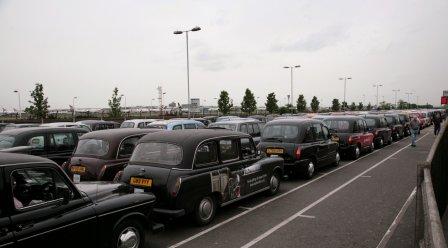
The black cab is one of London’s most famous icons. Along with Piccadilly Circus, Trafalgar Square and the Routemaster bus, it regularly features in stock footage for films set in the capital and retains a nostalgic appeal for many people, particularly visitors to London.
However, figures from Transport for London show a different side to the story. They reveal that, in 2007-8, the 21,000 black cabs in London produced almost the same amount of carbon dioxide (the main greenhouse gas) as the capital’s 46,000 private hire vehicles (PHVs) and even more of the emissions (PM10 and NOx) that are responsible for air pollution. So it is quite clear that black cabs have an adverse environmental impact, both on climate change and air quality, out of proportion to their numbers.
When Ken Livingstone was Mayor of London the annual licensing inspection for cabs was tightened up and in October 2007 an additional mid-year test was introduced. Nearly 40 per cent of cabs failed the test, with excess emissions a major factor. Despite this, Ken’s successor, Boris Johnson, has scrapped the mid-year inspection for black cabs – while retaining them for the less-polluting PHVs.
When I raised the issue of the pollution caused by black cabs at Mayor’s Question Time this month, Boris admitted that emissions of small particulates (PM10) were especially problematic for Londoners suffering from respiratory illnesses and said this issue needed to be “addressed”. But he refused to consider reinstating the twice-yearly checks.
The reason is not hard to find. Some of Boris’ most effective allies during his mayoral campaign were black cab drivers. According to his campaign office, they distributed over seven million receipts with the slogan “Back Boris” to their passengers – a figure equivalent to the entire population of London. In exchange, Boris made a number of promises to the cabbies, including the abolition of the six-monthly test.
It was not as though Ken had treated black cab drivers badly. He gave them exemption from the congestion charge, the right to use central London bus lanes and an increased night-rate tariff. But, unlike Livingstone, Johnson appears happy to sacrifice Londoners’ health and the struggle against climate change for short-term political gain.
Black cabs are a permanent and necessary part of London’s transport network and no one is proposing to replace them with PHVs. However, as things stand, for the eco-conscious Londoner who needs to use a taxi service, a licensed private hire minicab is the greener option. Black cabs need to clean up their act. The Mayor should take a lead on this crucial issue and do everything he can to reduce emissions – rather than pander to drivers’ convenience in pursuit of electoral advantage.