Archives – May, 2009

MAYOR AND DEFRA SET FOR AIR QUALITY SHOWDOWN

clean-up-your-act

During the same week that London Mayor Boris Johnson celebrated his first anniversary at City Hall, a report from the environment committee of the London Assembly, appropriately entitled Every Breath You Take, highlighted how bad the air quality in london was getting for its residents.

It confirmed that premature deaths and years of life lost caused by pollution in the capital is three times higher than claimed, confirming the city has the worst pollution levels in Britain and some of the worst in Europe.

This at the same time as the Government is under pressure to improve air quality as a result of European Union proceedings which began earlier this year following this country’s failure to comply with the directives on levels of PM10. This could mean Britain being fined up to £300 million.

So what’s the Mayor of London doing? So far, we’ve only seen backward steps from Johnson on this. Behind his charm and bluster, he has been actively dismantling measures to reduce pollution in London. He claims to be supporting 90,000 small van drivers by cancelling the next phase of the low emission zone, but he has lost sight of the approximately 107,000 people made ill in London each year by pollution levels. This is on top of Johnson’s plans to scrap the western extension of the congestion charge.

So there is a worrying disparity between the Government, which is legally bound to reach air quality standards, and the mayor and local authorities, which merely have to show they are “working towards” targets.

In the meantime, the Department for Environment, Food and Rural Affairs has submitted an application to extend its deadline by 2011 to avoid the fines. DEFRA is also looking seriously at its powers of direction over the London Mayor, following his decision to suspend the third phase of the city’s low emission zone. This would mean the Mayor would be directed to implement alternative measures to meet the air quality limits set out in the directives. And the expectation would be that he would put in place other measures Designed to deliver equal, if not greater, benefits to improve air quality than the third phase of the low emission zone, at the least.

So the showdown with DEFRA and the Mayor of London is very real. Unless Johnson can implement a big new idea to slash pollutants within the next 12 months, DEFRA will have to use the power of direction on the Mayor, as his decision to cut down the congestion charging zone and the scope of the low emission zone are proving to be ruinous for london’s environment.

Over to you, Hilary Benn.

Published in Tribune, 18 May 2009

Leave a Comment May 21, 2009

THE KILLING OF KELSO COCHRANE

kelso-cochrane-plaque

This weekend marked the 50th anniversary of the murder of Kelso Cochrane. Two commemorative events were held, an unofficial one at Kelso’s graveside in Kensal Green Cemetery and the other official one at the place where he was attacked, off Golborne Road.

On such a sober occasion, lessons of the past can enlighten the present and the future by comparing the events and context of 1958-59 with the present day, and by noting the struggle against racism since then and what it says to us about resisting racism now.

Kelso Cochrane was born in Antigua in 1927 and migrated to London in 1954, settling in Notting Hill. On 17 May 1959, while walking home from Paddington General Hospital where he had received treatment after a work accident, he was attacked by a group of white youths and stabbed to death. More than 1,200 people attended Kelso’s funeral.

Oswald Mosley’s Union Movement was active in Notting Hill at that time, and Colin Jordan’s White Defence League had its headquarters in Princedale Road. The previous year, a series of violent attacks on black people had culminated in the Notting Hill “race riots” in which white mobs of up to 400 people attacked the houses of West Indian residents.

In 1961 a local Mosleyite named Peter Dawson told the Sunday People that a Union Movement member was responsible for killing Kelso. However, the police denied that the attackers were motivated by racism and nobody has ever been charged with the murder.

Looking back on the terrible events of 1958-59 – the Notting Hill riots and the murder of Kelso Cochrane – we are able to see how far we have come since then. Today, the sight of 400-strong mobs of white racists rampaging through North Kensington or indeed any multi-ethnic area of inner London, attacking the homes of minority communities, seems inconceivable.

Of course, racism and fascism remain a threat – the election of a fascist to the London Assembly last May bears witness to that. But the BNP’s support is mainly restricted to a few areas of outer London. In inner London, people are at ease with multiculturalism and diversity, and the far right are marginalised. In the West Central GLA constituency which includes Notting Hill, the BNP got a paltry 2.4% of the vote in last year’s Assembly elections.

This situation is a tribute to the activists who have fought racism and fascism during the half a century since Kelso’s death.

It was the whipping up of an atmosphere of violent racism by Mosley’s Union Movement and Jordan’s White Defence League that led directly to Kelso’s murder. Due to the subsequent campaigning by anti-racists, in 1965 the Race Relations Act criminalised incitement to racial hatred, so that racists and fascists are no longer free to behave like that today.

And the struggle against racism was conducted on a cultural level too. The 1958 riots and Kelso’s murder produced the train of events that led to the launch of the Notting Hill Carnival – a celebration of Caribbean culture that brings together hundreds of thousands of Londoners from all of our city’s diverse communities.

It is not accidental that since his election last year the BNP’s London Assembly Member Richard Barnbrook has repeatedly used Mayor’s Question Time to attack the Notting Hill Carnival and call for its suspension.

In that context, I think it is a disgrace, and an act of appalling political irresponsibility, that the current Mayor of London, Boris Johnson, has cancelled Rise, the biggest anti-racist festival in Europe. I am pleased to report that at the next meeting of the London Assembly my colleague Jennette Arnold will be presenting a mass petition calling on Boris to reinstate Rise.

Unless there is a continuous struggle against racism and fascism they will return again. The best way that we can commemorate the death of Kelso Cochrane is to continue that struggle today.

And we also need to get justice for Kelso’s family, who have to live with the thought that his killers may still be walking the streets. At the official unveiling of the plaque on Sunday the family made a plea for the individuals who committed the crime to be found and prosecuted – not because they are looking for revenge but simply because they want justice.

3 Comments May 18, 2009

LOW CARBON ECONOMY: THE NEW HOLY GRAIL

fitting-solar-panels

The creation of a “low carbon” economy that will provide jobs and clean up industry is now a crucial policy objective for countries trying to spend their way out of the world economic downturn. A recent report by HSBC calculates that the United States is allocating 12 per cent of its fiscal stimulus to the green economy and China, 34 per cent.

There is a compelling scientific, economic and strategic case for low carbon development and the first movers have a lot to gain with worldwide investment in renewable energy having grown by 65 per cent a year since 2004, and projected to reach $600 billion a year by 2020.

China’s 11th Five-Year Plan (2006-10) includes a target to reduce energy intensity by 20 per cent during that period. This would translate to a saving of emissions around four times greater than the European Union’s current commitment under the Kyoto Protocol.

But despite these ambitious objectives China’s total greenhouse gas (GHG) emissions are already on par with those of the US and rising fast. This is clearly driven by the imperative of economic growth for China’s 1.3 billion people. China thus faces a qualitatively different challenge to the one that faced by industrializing nations in the past: of combining rapid industrialization, urbanization and poverty reduction with the transition to a low carbon economy.

No country has ever done this before, but the Chinese appreciate that carrying out the work of energy conservation and emission reduction and coping with climate change is a requirement of the Scientific Development Concept.

In response to the challenge of achieving a low carbon economy in China, a number of research institutes working with Chatham House in London have developed the concept of low carbon zones (LCZs). These will aim to stimulate transformational regional political leadership in a similar fashion to the special economic zones (SEZs) in the early 1980s, which gave certain regions the power to introduce more liberal economic regulations than the rest of the country, with some spectacular results.

Under the LCZ scheme, designated regions could be granted similar powers to experiment with a low carbon policy. To qualify for the LCZ status, regional leaders would have to commit to low carbon standards beyond the existing benchmarks at the national level.

These LCZs could then attract hi-tech foreign direct investment through measures such as strong patent protection, tax incentives and targeted recruitment of skilled workers. They could attract new types of carbon finance, too, by building the institutional capacity required to support local emissions trading schemes, drawing on international experience and underpinned by strong monitoring and reporting systems.

Furthermore, allowing them to pilot harmonization of standards with Europe in key low carbon sectors such as vehicle emissions, energy using products and construction would help facilitate Chinese exports and enhance trade and investment flows in the LCZs.

A second variant of the LCZ can be found in the UK, where there are similar proposals but on a smaller scale and mainly in the context of local rather than regional government. Cities are massive producers of carbon dioxide not just from traffic, but also from more energy use in buildings. So it is not surprising to hear calls to introduce a rolling program of LCZs aimed at dramatically improving the energy efficiency of all buildings — public and commercial premises and especially houses.

Here a precedent exists in the smokeless zones of the 1950s, which reduced pollution arising from the use of coal after the smog of 1952 killed 4,000 people in London. These LCZs could be rolled out across the country incrementally, with local authorities declaring an area to be an LCZ. Private sector partners would then be invited to deliver the actual service.

These partners would assess each building or house for energy efficiency and design and implement individual energy saving regimes. Within a specified time, it would become mandatory for all properties in the zone to reach the minimum ratings of energy efficiency.

A range of technologies and measures is available to ensure that energy efficiency addresses the whole property, and many of the measures will pay for themselves through lower bills. Focusing the zones on neighborhoods has great advantages because there are economies to be made from concentrating on defined areas and scope — for example, by introducing combined heat and power plants. This second form of LCZ was proposed by the last administration at London’s City Hall by the then deputy mayor.

Designing and implementing effective policies to drive the transition to a low carbon economy and share the costs equitably is a major political challenge for governments across the world. As we pursue the low carbon route to future economic development, LCZs both in their Chinese and UK variants offer an important means of dealing with the challenges ahead.

Published in China Daily, 5 May 2009

Leave a Comment May 8, 2009

BORIS: PROGRESSIVE IMAGE IS JUST SPIN

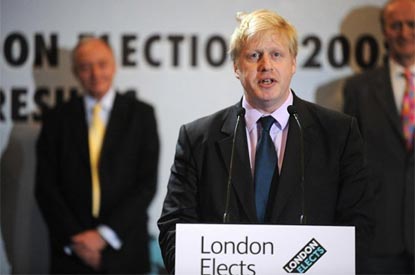
boris-johnson-election-2008

During last year’s London mayoral election, Ken Livingstone argued that underneath Boris Johnson’s affable, buffoonish persona there was a hardline right-winger. Johnson’s writings for the Tory press over the years certainly provided material to substantiate that charge.

Here was a man whose response to the emerging environmental crisis was to applaud George Bush’s refusal to sign the Kyoto Protocol, assert that there was “no evidence that the planet is suffering from the extreme weather patterns associated with climate change” and dismiss concerns over global warming as the modern equivalent of “a Stone Age religion”.

One of the few politicians since Enoch Powell to regard “piccaninnies” as an acceptable term, Johnson attacked the Macpherson inquiry into Stephen Lawrence’s murder as “Orwellian”, reacted to the July 7 bombings with the provocative and divisive comment that “the problem is Islam” and denounced multiculturalism for undermining “Britishness”. The fascist British National Party found sufficient common ground with Johnson to urge its supporters to cast a second-preference vote for him at the 2008 mayoral election.

Since taking office last May, he has changed his tune. Like Groucho Marx, Boris has his principles and if you don’t like them, he has others. As a journalist on the Daily Telegraph and the Spectator, he was happy to cater to the reactionary prejudices of his readers. As London Mayor, he now presents himself as an enthusiast for the capital’s multi-ethnic diversity and a born-again environmentalist. This is in line with David Cameron’s strategy of rebranding the Tories as progressives who have renounced bigotry and embraced green issues.

However, with a few exceptions, notably his backing for the London living wage and support for an amnesty for irregular migrants, Boris’ conversion to progressive politics remains on the level of rhetoric. His political practice is very different.

Nowhere is this clearer than on the environment. Despite his election pledge to “take action to make London the greenest city in the world”, his decisions in office point to someone who is more concerned about the rights of private vehicle drivers than the environmental damage they cause. Despite the fact that 1,000 people die prematurely in London each year because of poor air quality, he has suspended the third phase of the Low Emission Zone, scrapped Ken Livingstone’s £25 congestion charge on gas-guzzling vehicles and intends to halve the size of the Congestion Charge Zone. His plan for “restructuring” City Hall, which proposes the deletion of more than 140 posts, will reduce the environment team by half. And while Johnson uses his own enthusiasm for cycling to advertise his green credentials, this hasn’t prevented him from cutting the budget for cycle lanes by £10 million.

Johnson’s proclaimed admiration for multi-ethnic London has also proved at odds with his actions. The Rise music festival was stripped of its anti-racist message in 2008, and this year the Mayor’s office announced that the event would be abolished entirely. Further, another consequence of his proposed restructuring is that the stakeholders team who liaise between the Mayor and London’s minority communities will be restructured out of existence.

When we come to Johnson’s transport policies, we find that he has raised fares, wasted money and abandoned essential infrastructure projects.

In January, tube and bus passengers saw their fares rise by an average of 6 per cent and for some by a whopping 11 per cent. Johnson has made much of his decision to freeze the Greater London Authority element of London council tax in this year’s budget, which will save the average household in the capital just £6 a year. At the same time, thanks to his fare increases, the average Londoner will be between £100 and £300 a year worse off.

He has pressed ahead with his expensive and counterproductive plan to phase out articulated buses. Transport for London figures show that converting the first three bendy bus routes to double and single-deckers will cost over £3 million extra per year. The number of buses required to maintain current capacity on these routes will increase from 47 to 76 during peak hours, meaning longer journey times, more congestion and more pollution.

Johnson has also dropped support for the Thames Gateway Bridge, the Docklands Light Railway extension to Barking and Dagenham, the Greenwich Waterfront Transit and the Brixton to Camden Cross River Tram – all projects that would have helped poorer parts of London.

Johnson’s housing programme is equally regressive and there is little chance of his stated objective of 50,000 new affordable homes by 2011 being achieved. He has scrapped Ken Livingstone’s target for 50 per cent of all new housing to be affordable, and is instead negotiating individual borough targets which allow Tory councils to evade their obligation to provide sufficient numbers of new affordable homes. In addition, Johnson has shifted the emphasis from social rented housing towards part-buy part-rent schemes aimed at middle-income families. This is at a time when a third of a million households are already on the social rented waiting list – a figure which will inevitably rise even higher during the recession.

As an unabashed free-market enthusiast who dismisses criticism of the bankers or proposals for tighter controls over the financial sector as “neo-socialist claptrap”, Johnson has failed to develop an interventionist response to the economic downturn. His “Economic Recovery Action Plan” consists of little more than re-announcements of old initiatives, mostly those of his predecessor, and support for the work of central government and others. He has been criticised by major retailers, including Marks & Spencer, Selfridges and John Lewis, for not acting quickly enough to help business through the recession. And he has axed nearly £6 million of funding to projects working to give vulnerable Londoners the necessary skills to find employment when the economy revives.

Johnson has tried to cover up his real politics with gimmicks and spin, but Londoners are beginning to see through this. His attempt to promote himself as a defender of women’s rights at the recent launch of his domestic violence strategy fell flat when critics pointed out that his election promise to provide £744,000 to fund four rape crisis centres had been ditched, with only £233,000 being pledged – not even enough to keep London’s one existing centre open.

In short, if we look behind Boris’ new “progressive” image, what we see at City Hall is very much a traditional right-wing Tory administration. When it comes to social provision or economic regulation Johnson adheres to the Thatcherite view that the least government is the best government and he pursues a cost-cutting agenda without concern for its impact on services or the environment, while at the same time penalising the poorest sections of society. One year of Boris Johnson gives us an indication of what we can expect from four years of David Cameron, if the Tories win the next general election.

Published in Tribune, 1 May 2009

Leave a Comment May 3, 2009


Categories

Links

Meta