The Indian election will be an impressive spectacle, with 543 parliamentary seats and 4,145 assembly seats being contested in a rolling poll over four weeks from the 16th of April to early May. India has 28 states many of which are the size of a large European nation, with 20 official languages and a demography that covers seven major religions and more than three thousand social groups. This makes the Indian election not only the biggest but also the most diverse exercise in democracy in the world. Furthermore, for the first time, the polls will be all-electronic affair, with the deployment of 1.36 million advanced voting machines which is attracting interest abroad including in the US and Europe.
Now that’s just the process. If we look at the forces in play during the election, the major ones include regionalism, the caste system and finally the internal threat from Maoist guerrillas.
The reality is that the country has only two national parties – Congress and the Hindu revivalist Bharatiya Janata Party (BJP) – which can only come to power on the back of coalitions with regional parties. For example the governing Congress heads a coalition of 13 parties which at the last election replaced a 23-party coalition led by the BJP. This makes government at the centre incredibly difficult, as the compromises required to maintain the ruling coalition can paralyse government from Delhi, leaving the regional parties to rule their fiefdoms much as they desire.
Then we have casteism. A large part of the explanation of the loss of appeal of the national pan-Indian parties is explained by the existence of the thousands of social groups whose political allegiances are reflected in parties that represent their particular social interests. The best example of this is the Bahujan Samaj Party which represents the Dalits who form the “untouchables” at the bottom of India’s caste system, particularly in South India. Their leader is the populist Mayawati who is set to play the kingmaker in this year’s election, and she invariably backs the party at the centre that looks the easiest to blackmail.
And finally we have the threat posed to the elections by the Maoist guerrillas, otherwise known as the Naxalites, who operate in 13 out of the 28 states of India and have control of large swathes of the country. They pose a major security threat, to the extent that India will not be hosting their lucrative IPL Twenty20 cricket tournament as the government can not provide enough security to cover both that event and the month-long general election campaign. The actions of the Naxalites, who are violently opposed to the election, will affect the turnouts in the states in which they operate.
This all makes for an interesting time over the coming month. Watch this space, as we will no doubt see many twists and turns during the election, and unpredictable events during the four weeks from the 16th of April can influence the eventual outcome.
It was good to see London acting as a venue and host on the international stage to world leaders at the G20 London Summit, which marked the latest stage in the emergence of a new economic order in which western domination is being challenged by rising powers like China – something l’ve spent time studying since my student days.
But, for most Londoners, the Summit is probably going to be remembered for the way the Met policed the demonstrations and the circumstances surrounding the tragic death of Ian Tomlinson. l myself went on the “Put People First” demonstration on the Saturday before the Summit, and as someone who has been to similar demos over the years l have noticed that the Met’s policing of events has got much heavier, both in terms of numbers and tactics, to the extent that some feel it is threatening people’s cherished right to assemble and protest.
Not surprisingly, l have received a number of communications criticising the methods adopted by the police. The Labour Group on the London Assembly have called for a full and open debate on the legitimacy and appropriateness of the tactics used. The police have a duty to explain and justify their actions and we have called for a full report to be made to the Metropolitan Police Authority, where our representatives (Jennette Arnold, John Biggs and Joanne McCartney) will be able to question the police.
The next MPA meeting is on 30 April, giving them ample time to give an account of their actions, and in the meantime we will see how the police deal with the Tamil protesters in London in the wake of the G20 controversy.
The 8 April statement by the London Assembly Labour Group on the death of Ian Tomlinson can be read here.
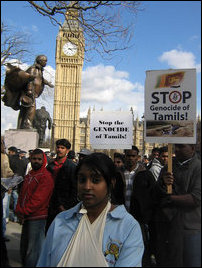
The protests by Tamil demonstrators at Parliament Square this week have had the effect of at last drawing the media’s attention to the appalling plight of Tamil civilians caught behind the lines in the war in Sri Lanka.
By contrast, in January a massive 100,000-strong march in London by the Tamil community demanding a ceasefire attracted virtually no media coverage at all. It is depressing to think that the killing of innocent people in Sri Lanka becomes newsworthy here in the UK only when it results in the disruption of traffic across Westminster Bridge.
Tens of thousands of civilians are now trapped by the fighting between the Sri Lankan army and the Liberation Tigers of Tamil Eelam, who launched an armed struggle for an independent Tamil homeland more than a quarter of a century ago.
According to the United Nations, over the last two months more than 2,800 civilians have been killed and 7,000 injured. The army continues to shell the small coastal area still held by the Tigers, apparently without regard for the fate of non-combatants.
Only yesterday it was reported that 22 people, including an 18-month-old child, were killed and 283 injured after shells landed near two health facilities, one of them a mother and baby clinic where 500 people were queuing for milk powder and food rations.
If the Sri Lankan government insists on continuing with its military campaign until the LTTE forces have been destroyed, the number of civilian casualties does not bear thinking about.
Perhaps Sri Lankan president Mahinda Rajapakse calculates that a crushing military victory over the Tigers will enhance the standing of his Sri Lanka Freedom Party among the Sinhalese majority population, thus ensuring a comfortable victory in the parliamentary elections due early next year.
If so, this is not only immoral but extraordinarily short-sighted. The military defeat of the Tigers, accomplished at the cost of so much bloodshed, will only pile up yet more bitterness among the Tamil population and inevitably produce further armed conflicts in the future.
Without an immediate ceasefire, followed by a political solution addressing the long history of oppression suffered by the Tamil minority that is the root cause of the war, Sri Lanka will remain locked in bloody conflict for generations to come.
I am pleased to see that David Miliband has called for a ceasefire and I fully support the proposal by Keith Vaz that the crisis should be debated as a matter of urgency by the United Nations Security Council.
The text of a letter I sent to the Sri Lankan High Commissioner on 18 March can be consulted here.
I have commented on the issue of identities before on this blog, for example in connection with Sikh girl Sarika Watkins-Singh’s successful court case over her right to wear a Sikh bangle to school, which I related to Amartya Sen’s writings on multiple identities. So I thought I should go on record about my own experience of the issue, in a video shot on the Middle East street of London, Edgware Road, in my own neighbourhood. I hope it is of interest to you all.
Produced by Progressive British Muslims and Dog Eared Films
In my last blog l suggested that the most important meeting to be held during the G20 London Summit would be the G2 meeting for the first time between US President Barack Obama and the Chinese President Hu Jintao, a point also made by the Economist.
Now, what do you think is uppermost in the minds of the Chinese? Well, it is not the regulation of global finance, particularly hedge funds, as it is for the French and the Germans. It is not a continued fiscal stimulus to the global economy, as it is for the United States and United Kingdom. Nor is it how the G20 can prevent a retreat into protectionism and promote free trade, in circumstances where many economic historians point out the parallels with the 1930s. Nor is it how the IMF will need more money to bail out countries going bust like Iceland, Hungary and Ukraine – since the Chinese have already agreed to help as long as the IMF is reformed and China has more say. Nor is it a clampdown on offshore tax havens, as governments desperately attempt to bring as much revenue as possible back onshore to boost state coffers. Nor is it environmental and development concerns, as the Chinese are starting to pursue a low carbon future and have already become a major source of funds to the developing world.
No, it’s China’s plan to end the dollar era. In China it appears to be a debate between the likes of Zhou Xiaochuan, governor of China’s central bank, who has put forward a credible proposal for a reserve currency to rival the greenback (Financial Times, 24 March), and the likes of Professor Yu Qiao of Tsinghua University discussing how Asia can protect itself from a dollar default (Financial Times, 1 April). The latter response is not surprising given that the Chinese are the largest holder of US dollar financial assets and they express the same anxiety as savers who fear a run on a bank. So it is understandable that China wants to replace its mountain of dollar assets with heaps of other currencies. It would be in China’s interest to have another safe reserve currency and take an active role in the reshaping the world monetary economy.
So while the focus during the next day or so will be on all the other issues mentioned above, in the long run the G20 London summit is going to be remembered as the beginning of a process, possibly taking up to 20-odd years, to replace the greenback and a world economy working for the Yankee dollar.