Archives – March, 2009

Boris Johnson demonstrated his neo-liberal credentials once again in his latest Daily Telegraph column by suggesting that the slogan for the G20 protestors (or “the G20 mob” as he prefers to call them) should be “What do we want? Free trade!” My response would be “Jobs, justice and climate” – the banner under which tomorrow’s G20 demonstration in London has been organised.
The dual challenge for the G20 Summit, the main thrust of which is a major fiscal stimulus and banking reform to counter the global recession, is to promote economic recovery without further damaging the environment and to limit the impact of the economic crisis on the developing world.
It is crucial that development assistance should be maintained, at a time when aid and Foreign Direct Investment have fallen and the populations of developing states increasingly rely on money transfers from migrants in the developed world.
Also, the developed world must keep to its commitments made at the 2007 Bali conference on climate change, in preparation for the negotiations over the post-Kyoto agreement in Copenhagen at the end of this year – that is, to trim our own lifestyles while allowing poorer countries to develop without strings and conditions, and assisting them with technology transfer and innovative finance.
As Nicholas Stern and his colleagues have recently pointed out (in An outline of the case for a ‘green’ stimulus), in the developed world the best way to boost employment during a recession while at the same time reducing carbon emissions is to invest in new green industries like renewable energy projects. We should put more money into energy efficiency rather than exporting our waste to the developing world.
Examples already exist. In the USA, Obama’s economic package proposes to put billions of dollars into green jobs. A third of China’s recovery programme is in creating green jobs. And Germany is directing 19 per cent of its recovery expenditure into new green industries.
London needs to show that we can do this as well. With just over 50 per cent of humanity now living in cities, which are responsible for 75 per cent of CO2 emissions, we could make a real difference. The commitment of our current Mayor to the ideology of neo-liberalism is of course a major obstacle here.
That said, the main show at the G20 will be Obama’s first meeting with the Chinese premier. At the end of the day, it’s the G2 who will determine what really happens to the world economy.
March 27, 2009

Because of security concerns following the terror attack against the Sir Lankan cricket team in Lahore last month, one of the most lucrative sports franchises, the Indian Premier League (IPL) for Twenty20 cricket, is having to go abroad for this year’s competition. And the choice is a straight one between England or South Africa.
I am pretty certain that, for most of the viewing public in the Indian sub-continent, there can only be one place to host the event – and that is England, the home of cricket. Many of them will have grown up dreaming of playing or even just watching a game at Lords or the Oval. So, if this new form of league cricket taken from the street game has to go anywhere, it should be here in the United Kingdom.
In addition, we already have the facilities, organisational manpower and a passionate fan base that will generate a huge amount of interest here too.
With 59 matches scheduled between 10 April and 24 May, hosting the IPL would also greatly help the economy in London in the present downturn, by bringing in cricket fans to take up empty hotel rooms, increasing restaurant bookings and boosting visits to other tourist destinations. It would also enhance London’s status as a great sports location for future events. So hopefully a package can be offered to the IPL to make them feel happy to come over to England.
March 23, 2009

Last night l attended a showing of The Age of Stupid at the Tricycle Theatre, Kilburn. The film comes out at an important time – before the G20 Summit in London next month and the Copenhagen meeting of the post-Kyoto negotiations of the UN on climate change in December. It’s certainly worth seeing.
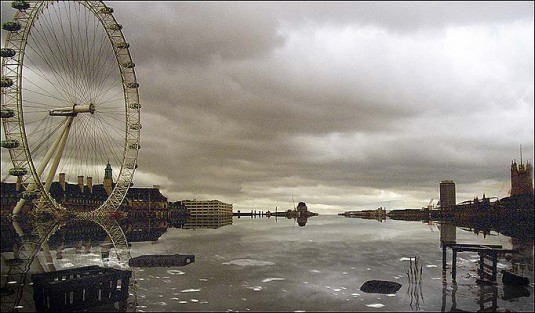
The Age of Stupid is very much in keeping with the times, with its lack of faith in markets and capitalism in its present form. It links its climate change analysis with political events in the Middle East. And it has some useful graphics of how London would look if it was flooded by the Thames (see below).
Because of its subject matter and its documentary format, there is an obvious comparison with An Inconvenient Truth. But The Age of Stupid is a much better film, as it gives far more emphasis to the role of people power rather than key individuals like Al Gore in changing the world.
We shouldn’t forget that for all his green talk, Gore failed to get the US to ratify the Kyoto agreement while getting the rest of the world to accept some tough medicine like tradable permits. So much for ecotoffs! This illustrates well that the campaign over climate change is not that dissimilar to the fight for universal suffrage or against apartheid. To be successful it requires a struggle organised at grassroots level.

March 23, 2009

Painting by Lakshmi Shree, India
Asian countries have an important stake in this year’s climate change negotiations and, as a result, a critical part to play in the negotiations.
Climate change is hitting the Asian continent already and big global decisions will be made this year. An agreement to cut greenhouse gases emissions will hopefully exceed what the Kyoto agreement previously negotiated.
The negotiations over the rest of the year will culminate in the new Copenhagen Agreement in Denmark in December 2009 at the 15th conference of the parties (COP 15) on the United Nations Framework Convention on Climate Change (UNFCCC).
The main focus, agreed just over a year ago at the 13th conference of the parties in Bali, Indonesia, consist of four building blocks, of which two – “Mitigation” and “Adaptation” – are considered major.
The former denotes actions by the major emitting countries to reduce their emissions and to prevent that future dangerous climate change. The latter seeks to ensure that countries vulnerable to the adverse impacts of climate change are duly assisted with technology and funding to cope. The other two building blocks include technology transfers for both mitigation and adaptation and innovative financing for mitigation and adaptation.
The most immediate concern for Asia is the issue of Adaptation and funding for it. Estimates of global adaptation funding range from tens to hundreds of billions of dollars a year. These funds will need to come from “new and additional” sources not from previously rolled out development assistance.
A number of proposals to raise such significant sums for adaptation already exist, including a proposal by Bangladesh and formally adopted by the least developed countries (LDC) group at the Poznan meeting to charge an “adaptation levy” on all international air passengers. Estimates put the total figure at more than $10 billion a year.
Even if the LDC proposal ultimately falls over, at least it gives the group a strong card to play against other countries. They will need to assure funding in the tens of billions of dollars for adaptation to be acceptable to the LDC group, as well as other vulnerable countries and Africa group.
Asian countries need to use their strong presence within the LDC Group to build bridges and establish a common negotiating position with these other groups of most vulnerable countries, and the African group.
The focus on adaptation, however, should not distract us from also paying attention to the other major building block, mitigation, and formulating a clear strategy on the issue.
At the moment the strategy of countries like Bangladesh, together with the LDC group, is to call for a target temperature rise of “well below two degrees centigrade”. While not avoiding some damage, this will enable the world to survive climate change. Such an ambitious global temperature target is still far from certain as it will require very strong mitigation actions to be undertaken first by the developed countries and then also by some of the major developing countries.
Published in China Daily, 17 March 2009

Mainland Asia has a common source of water – the Tibetan glacier
March 19, 2009

Normally l’m knocking Boris on this blog, but I fully back the position he has taken over the issue of irregular migrants in London, as outlined in his interview on the Panorama programme “Immigration – Time for an Amnesty?” broadcast on the 9th of March.
That is, it’s impractical to expel the hundreds of thousands of irregular migrants already here and another solution is required. If they are making a contribution to society, we should regularise their status – as long as they have no criminal record, they have the ability to support themselves and their families, and they have been here for a considerable period of time.
Under instructions from the Mayor, GLA Economics has commissioned a study from the LSE on the economic impact of such an amnesty. It is as yet available only as an interim summary with a draft of the key Chapter 2, “Estimating the Size of the Target Population”, which puts the number of irregular migrants in London at around half a million.
With the Tory party leadership against an amnesty and his media backers like the Evening Standard opposed as well, it may seem surprising that Boris should have taken this stance.
No doubt it is part of his attempt re-brand himself as a friend of minority communities, after all the adverse publicity he faced during the mayoral election campaign last year over his comments about “piccaninnies” and “watermelon smiles”.
It should also be remembered that in deciding to commission a report on the economic impact of regularisation Boris was in large part responding to a motion in favour of an amnesty passed by the progressive alliance between Labour, the Greens and the Lib Dems on the London Assembly last October. The Tory Assembly Members voted against the motion along with the BNP’s Richard Barnbrook.
Nevertheless, credit where it’s due, Boris has taken the right line on this and his support for the principle of regularisation should be welcomed.
March 11, 2009
Previous page